
If you’re thinking about relocating, whether across town or across the country, you’re not alone. Nearly 15 million Americans moved in 2025, and the patterns they followed reveal a great deal about where opportunity, affordability, and quality of life are heading. New data from HireAHelper and the U.S. Census Bureau show clear winners and losers when it comes to population growth, and understanding those trends can help you make a smarter, more informed decision about your own move.
Whether you’re considering a local move within Pennsylvania, a state-to-state relocation, or a long distance interstate move to one of the country’s fastest-growing regions, here’s what the data tells us and what it could mean for you.
The Big Picture: Where Americans Moved in 2025
The dominant story of 2025 migration was the continued appeal of the South and Mountain West. States in these regions attracted the most new residents on a per-capita basis, driven by lower costs of living, warmer climates, and growing job markets. At the same time, several high-cost coastal and Northeast states continued to shed residents at a notable rate.
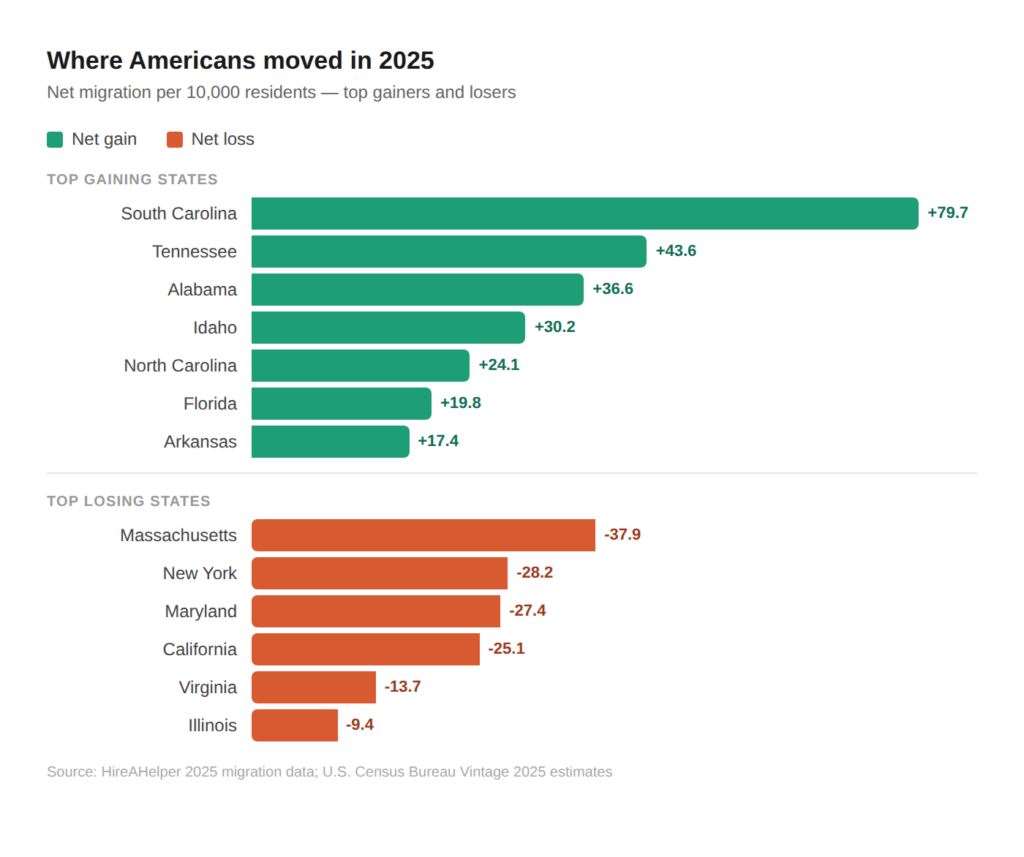
The top gaining states (net migration per 10,000 residents) included:
- South Carolina (+79.7)
- Tennessee (+43.6)
- Alabama (+36.6)
- Idaho (+30.2)
- North Carolina (+24.1)
- Florida (+19.8)
The top losing states included:
- Massachusetts (−37.9)
- New York (−28.2)
- Maryland (−27.4)
- California (−25.1)
- Virginia (−13.7)
One notable shift: Texas and Florida. The undisputed migration magnets of the past decade moved into “balanced” territory for the first time in recent memory, meaning roughly equal numbers of people were moving in and moving out. The Sun Belt boom is moderating, and new destinations are stepping into the spotlight.
Why Are People Moving? The Driving Forces Behind 2025 Relocation Trends
Understanding why people are moving is just as important as knowing where. The same forces driving national migration trends are likely influencing your decision, too.
Affordability
Housing costs and state income taxes remain the top reasons people leave high-cost states. California carries the nation’s highest state income tax rate, while median home prices have pushed well beyond what many middle-income families can afford. New York, Massachusetts, and Maryland face similar pressures. By contrast, states like South Carolina, Tennessee, and Alabama offer significantly lower costs of living and that gap is driving real, measurable population shifts.
Remote and hybrid work
The rise of remote and hybrid work has decoupled income from geography for millions of Americans. Workers who once had to live near a major metro to access good jobs can now choose where to live based on lifestyle and budget. This has fueled long distance interstate moves that simply wouldn’t have happened six years ago.
Quality of life and climate
Warmer weather, access to outdoor recreation, and a lower-stress pace of life are increasingly factoring into relocation decisions, especially among retirees and young families. States like North Carolina and Tennessee have emerged as sweet spots that combine outdoor access, affordable housing, and growing urban amenities.
What This Means If You’re Moving to a High-Growth State
If your destination is one of the country’s fastest-growing states, there are a few practical realities to keep in mind as you plan your state-to-state move.
Housing inventory moves fast
In high-demand markets like the Carolinas and Tennessee, homes are selling quickly. If you’re buying, be prepared to move fast once you find a property and build flexibility into your moving timeline in case your closing date shifts. Temporary storage can be a valuable buffer between your departure and your new home being ready.
Book your mover early
Moving companies serving popular inbound corridors like the Northeast to Southeast or Midwest to Mountain West fill up quickly—especially during peak season in the spring and summer months. If you’re planning a long distance interstate move to a growing region, securing your moving date several weeks in advance is strongly recommended.
Research your new community before you arrive
Rapid population growth can strain local infrastructure like schools, roads, utilities, and services. Before committing to a specific neighborhood, research school ratings, commute times, and local amenities. Talking to a local real estate agent who specializes in relocation buyers can be invaluable.
What This Means If You’re Moving Away from a Declining State
If you’re planning to leave a high-outbound state, the good news is that you have options and likely more leverage than you think.
You may have more selling power than expected
Despite population outflows, home values in many large coastal metros have remained relatively stable due to limited housing supply. If you own a home in California, New York, or Massachusetts, the equity you’ve built may go a long way in a more affordable destination market.
Plan your logistics carefully
Leaving a major metro (especially with a full household) requires careful coordination. Larger homes, more belongings, and longer driving distances all add complexity to a long distance move. Working with an experienced interstate moving company that handles the full move (not just where your move starts) will save you stress and potential extra costs.
Consider your move-out timing
In states with high outbound volume, moving companies can be heavily booked during popular departure windows, particularly June through August. The more flexible you can be with your dates, the better your options and pricing are likely to be.
A Surprise in the Data: The Midwest Is Bouncing Back
Here’s a trend that didn’t make as many headlines but deserves attention: in 2025 the Midwest saw positive net domestic migration for the first time this decade. States like Ohio and Michigan, which experienced significant population losses during the pandemic years, have begun to stabilize and even attract new residents.
For Pennsylvania residents considering a local move or regional relocation, this signals renewed confidence in the broader Midwest and Appalachian region. Factors driving this include lower home prices compared to coastal markets, a strong manufacturing and healthcare job base, and a growing recognition among remote workers that mid-sized Midwest cities offer an excellent quality of life at a fraction of coastal costs.
Local Moving vs. Long Distance: Choosing the Right Type of Move
Not every move is a cross-country relocation. The migration data above captures state-to-state movement, but many households are simply moving to a new neighborhood, a nearby town, or a different part of their state. Understanding the difference between move types helps you plan more effectively and choose the right moving partner.
Local moving
Generally defined as moves within the same state (or within 50 miles), local moving is typically priced by the hour. These moves tend to be more flexible in scheduling, but during peak season in spring and summer local movers fill up quickly. Even for a short-distance move, booking 4–6 weeks in advance is a smart strategy.
State-to-state and long distance interstate moving
Long distance and interstate moves involve more logistics: binding estimates, weight-based pricing, regulated carrier requirements, and longer lead times. If you’re joining the millions of Americans making a state-to-state move in 2025 or 2026, working with a nationally affiliated moving company gives you the coverage and accountability you need across both origin and destination.
At McNaughton Moving & Storage, we handle both. From local Pennsylvania relocations to long distance interstate moves across the country. As a trusted Allied Van Lines agent serving Western Pennsylvania since 1918, we have the network and expertise to get your belongings safely to your next destination, wherever that may be.
Ready to Make Your Move?
Whether you’re heading to a high-growth Sun Belt state, staying closer to home, or watching the Midwest renaissance unfold in your own backyard, the decision to move is a big one. Understanding the national trends can help you feel more confident about where you’re headed and why.
When you’re ready to take the next step, our team at McNaughton is here to help. Contact us for a free quote on your local, state-to-state, or long distance interstate move, and let’s start planning a relocation that works for you.
